

Blog Post
Beneath the Surface: How Helical Piles Save Sinking Pool Decks and Protect Your Backyard Investment
Posted in Articles
A swimming pool is often the centerpiece of a backyard, providing a place for relaxation, entertainment, and family gatherings. But when cracks begin appearing around the pool deck, concrete starts sinking, or sections of the deck become uneven, what was once a beautiful outdoor space can quickly become a safety hazard.
Many homeowners assume the problem is simply aging concrete. In reality, the issue often starts beneath the surface. Soil movement, erosion, and settlement can undermine the support beneath pool decks, causing them to sink over time. Fortunately, helical piles offer a long-lasting solution that addresses the root cause rather than simply masking the symptoms.
We take a look at why pool decks fail, the risks of ignoring settlement, and how helical pile systems provide a reliable method for stabilizing and restoring sinking pool decks.
Why Pool Decks Sink
Pool decks are constantly exposed to environmental conditions that can affect the soil beneath them. Unlike the pool shell itself, surrounding decks are often supported by compacted fill soil, which can shift or settle over time.
Common causes of pool deck settlement include:
Soil Erosion
Water is one of the biggest threats to pool deck stability. Leaking pool plumbing, poor drainage, irrigation systems, and heavy rainfall can wash away supporting soils beneath the deck.
Poor Soil Compaction
In many cases, fill dirt used during pool construction was not properly compacted. As the soil naturally settles, voids develop beneath the deck, causing sections of concrete to sink.
Expansive Clay Soils
Throughout Georgia, Florida, Texas, and other southern states, expansive clay soils expand when wet and shrink during dry conditions. This constant movement creates stress on concrete structures and can lead to settlement.
Tree Roots
Large trees near pools can draw moisture from surrounding soils, causing shrinkage and settlement beneath the deck.
Aging Infrastructure
Even properly constructed pool decks can experience settlement after years of exposure to changing moisture levels and environmental conditions.
Signs Your Pool Deck May Need Stabilization
Pool deck problems rarely appear overnight. Early warning signs often indicate underlying soil movement before major damage occurs.
Watch for:
- Cracks in the concrete deck
- Uneven deck surfaces
- Trip hazards between slabs
- Gaps between the pool deck and coping
- Standing water on deck surfaces
- Sections of concrete that appear lower than surrounding areas
- Separation between deck structures and adjacent patios
- Deck movement near retaining walls or slopes
If left unaddressed, these issues can worsen and create significant safety concerns for family members and guests.
Why Pool Deck Settlement Shouldn't Be Ignored
Many homeowners view pool deck cracks as cosmetic issues. However, settlement often indicates a larger structural concern beneath the surface.
Ignoring the problem can lead to:
Increased Safety Risks
Uneven surfaces create trip hazards around areas where people are often barefoot and moving quickly.
Continued Structural Movement
Settlement rarely stops on its own. Once supporting soils begin shifting, movement often continues unless stabilized.
Water Drainage Problems
A sinking pool deck can alter drainage patterns, directing water toward the pool structure or home foundation.
Costlier Repairs Later
Minor settlement may be corrected relatively easily, while severe settlement often requires more extensive stabilization efforts.
Reduced Property Value
Visible structural issues around a pool area can negatively impact curb appeal and property value.
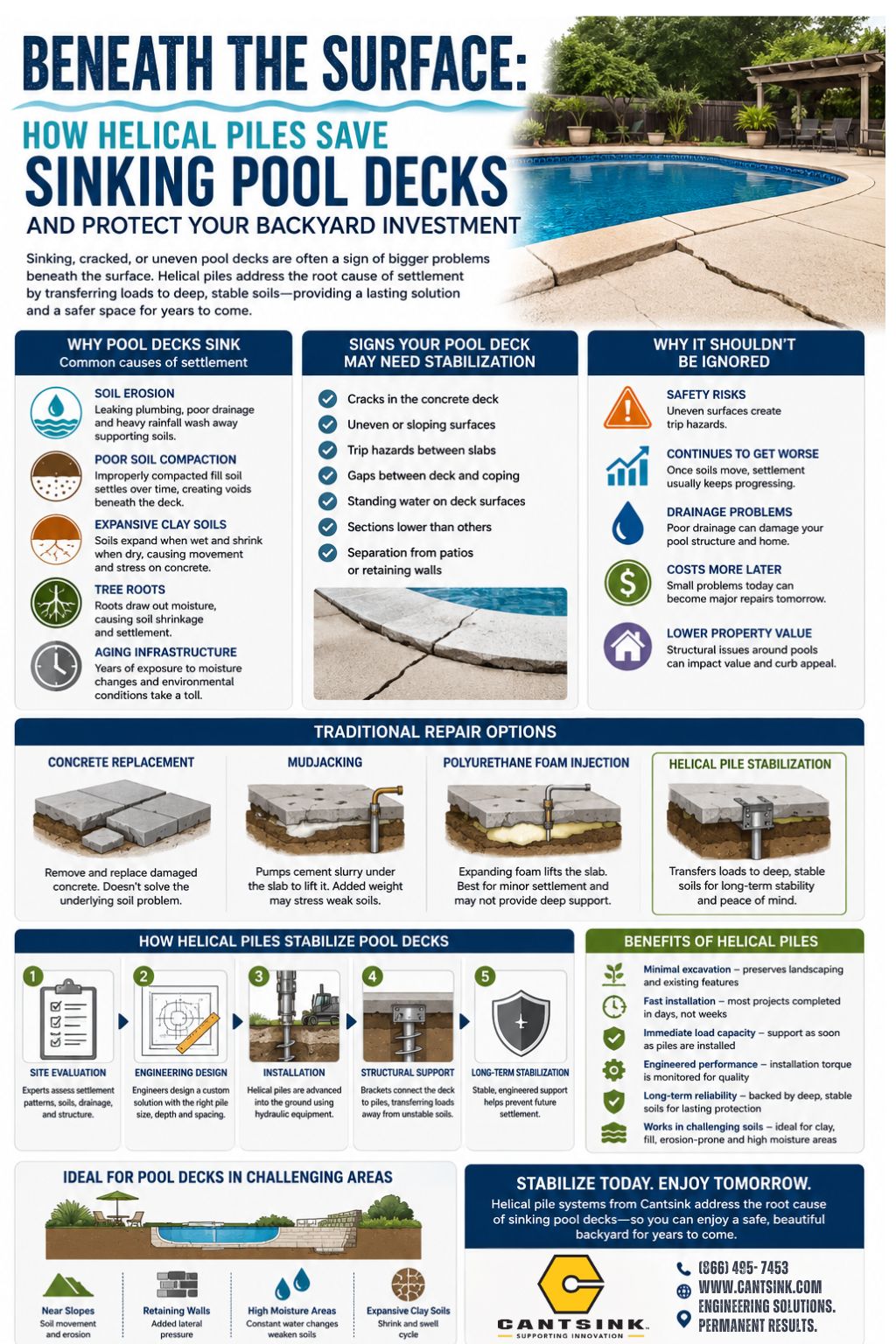
Traditional Pool Deck Repair Methods
Several repair methods are commonly used to address sinking pool decks.
Concrete Replacement
One option is removing and replacing damaged sections of the deck.
While replacement provides new concrete, it does not necessarily solve the underlying soil issue. If unstable soils remain, the new deck may eventually settle as well.
Mudjacking
Mudjacking involves pumping a cement-based slurry beneath settled concrete to raise it back into position.
Although this method can restore elevation, the added weight may place additional stress on weak soils. Results can also vary depending on site conditions.
Polyurethane Foam Injection
Foam lifting is a more modern leveling technique that injects expanding foam beneath settled slabs.
This solution can be effective for minor settlement, but it may not provide sufficient structural support when deeper soil instability exists.
Helical Pile Stabilization
Unlike surface-level repairs, helical piles transfer loads to deeper, stable soils. This approach addresses the root cause of settlement and provides long-term support.
What Are Helical Piles?
Helical piles are engineered steel foundation elements featuring one or more helical plates welded to a central shaft.
They are installed by rotating the pile into the ground using hydraulic equipment. As the pile advances, the helical plates anchor into stable load-bearing soils beneath weak surface layers.
Once installed, the pile creates a secure foundation support point capable of carrying substantial loads.
Helical piles have been used for decades in:
- Residential foundation repair
- Commercial construction
- Boardwalks and docks
- Retaining walls
- Solar installations
- Pool decks and outdoor structures
How Helical Piles Stabilize Pool Decks
When a pool deck begins settling, helical piles can be strategically installed beneath affected areas.
The process typically includes:
1. Site Evaluation
Foundation and geotechnical specialists assess:
- Settlement patterns
- Soil conditions
- Deck construction
- Drainage issues
- Load requirements
2. Engineering Design
Each project receives a stabilization plan based on site-specific conditions.
Engineers determine:
- Pile size
- Installation depth
- Load capacity requirements
- Pile spacing
3. Installation
Helical piles are advanced into the ground until they reach competent load-bearing strata.
Installation is performed using specialized hydraulic equipment and causes minimal disruption to the surrounding property.
4. Structural Support
Brackets connect the stabilized deck structure to the installed piles, transferring loads away from unstable soils.
5. Long-Term Stabilization
The result is a permanently supported structure designed to resist future settlement.
Benefits of Helical Piles for Pool Deck Repair
Minimal Excavation
Unlike traditional foundation replacement methods, helical pile installation requires limited excavation.
This helps preserve:
- Landscaping
- Hardscapes
- Irrigation systems
- Existing pool features
Fast Installation
Many pool deck stabilization projects can be completed in a matter of days rather than weeks.
Immediate Load Capacity
Helical piles provide immediate structural support upon installation.
Engineered Performance
Installation torque is monitored throughout the process, helping verify pile capacity and performance.
Long-Term Reliability
Because loads are transferred to deeper stable soils, helical piles help prevent recurring settlement issues.
Works in Challenging Soil Conditions
Helical piles are particularly effective in areas with:
- Expansive clay soils
- Loose fill soils
- Erosion-prone conditions
- High moisture fluctuations
Pool Decks Near Slopes and Retaining Walls
Pool decks located near slopes present unique stabilization challenges.
Erosion and soil movement near retaining walls often contribute to settlement problems. In these situations, helical piles may be incorporated into a broader stabilization plan that includes:
- Retaining wall reinforcement
- Tieback systems
- Drainage improvements
- Soil stabilization measures
This integrated approach helps protect both the deck and surrounding structures.
How Much Does Pool Deck Stabilization Cost?
The cost of pool deck stabilization varies depending on:
- Size of the affected area
- Severity of settlement
- Soil conditions
- Accessibility
- Number of piles required
- Engineering requirements
While surface-level repairs may initially appear less expensive, homeowners should consider long-term performance and the likelihood of future settlement.
A professional evaluation provides the most accurate assessment of repair options and associated costs.
Why Choose Cantsink for Pool Deck Stabilization?
For decades, Cantsink has helped property owners solve challenging soil and foundation issues using engineered helical pile systems.
Our team provides:
- Comprehensive site evaluations
- Engineered stabilization solutions
- High-capacity helical pile systems
- Experienced installation crews
- Proven performance in residential and commercial applications
Whether you're dealing with a sinking pool deck, pool stabilization issues, settling patio, retaining wall movement, or foundation issues, our team develops customized solutions designed for long-term stability.
Protect Your Backyard Investment
Your pool area should be a place for relaxation not a source of structural concerns and safety hazards.
If you've noticed cracking, settlement, or uneven surfaces around your pool deck, addressing the issue early can help prevent more extensive damage and costly repairs in the future.
Helical piles provide a proven, engineered solution that stabilizes sinking pool decks by addressing the underlying soil conditions responsible for movement. By transferring structural loads to deeper, stable soils, helical pile systems offer long-term protection and peace of mind.
Contact Cantsink today to schedule a professional evaluation and learn how helical pile technology can restore stability to your pool deck and protect your outdoor investment for years to come

