

Blog Post
Foundation Repair for Commercial Buildings: Warning Signs Property Owners Shouldn’t Ignore
Posted in Articles
A commercial building's foundation supports far more than walls and floors. It protects the people, equipment, inventory, and daily operations inside the property. When foundation problems develop, they can affect the building's structural integrity, appearance, value, and ability to remain operational.
Unfortunately, foundation damage does not always appear as one dramatic crack or sudden failure. Problems often begin gradually, with small warning signs that may be mistaken for routine wear and tear. A door that becomes difficult to close, a crack near a window, or an uneven floor may seem minor at first. However, these issues can indicate movement beneath the structure that may continue to worsen.
Recognizing the early warning signs of foundation trouble gives commercial property owners and facility managers an opportunity to investigate the cause before foundation repair becomes more complicated and disruptive. Here are the signs that should never be ignored.
Why Commercial Building Foundations Develop Problems
Foundation movement can occur for several reasons, but soil conditions and water are often major contributors.
Commercial buildings place significant loads on the soil beneath them. If the soil is weak, poorly compacted, expansive, or vulnerable to erosion, it may not provide consistent support. Different areas beneath the building can settle at different rates, creating a condition commonly known as differential settlement.
Several factors can contribute to commercial foundation problems, including:
- Poorly compacted fill soil
- Expansive clay that shrinks and swells
- Erosion caused by uncontrolled drainage
- Plumbing or utility-line leaks
- Changes in groundwater conditions
- Flooding or repeated storm activity
- Drought and prolonged dry weather
- Improper grading around the property
- Nearby excavation or construction
- Increased loads caused by renovations or new equipment
- Deterioration of existing foundation components
Some settlement shortly after construction can be normal. However, continued movement, uneven settlement, or new structural symptoms years after construction may signal a problem that requires professional evaluation.
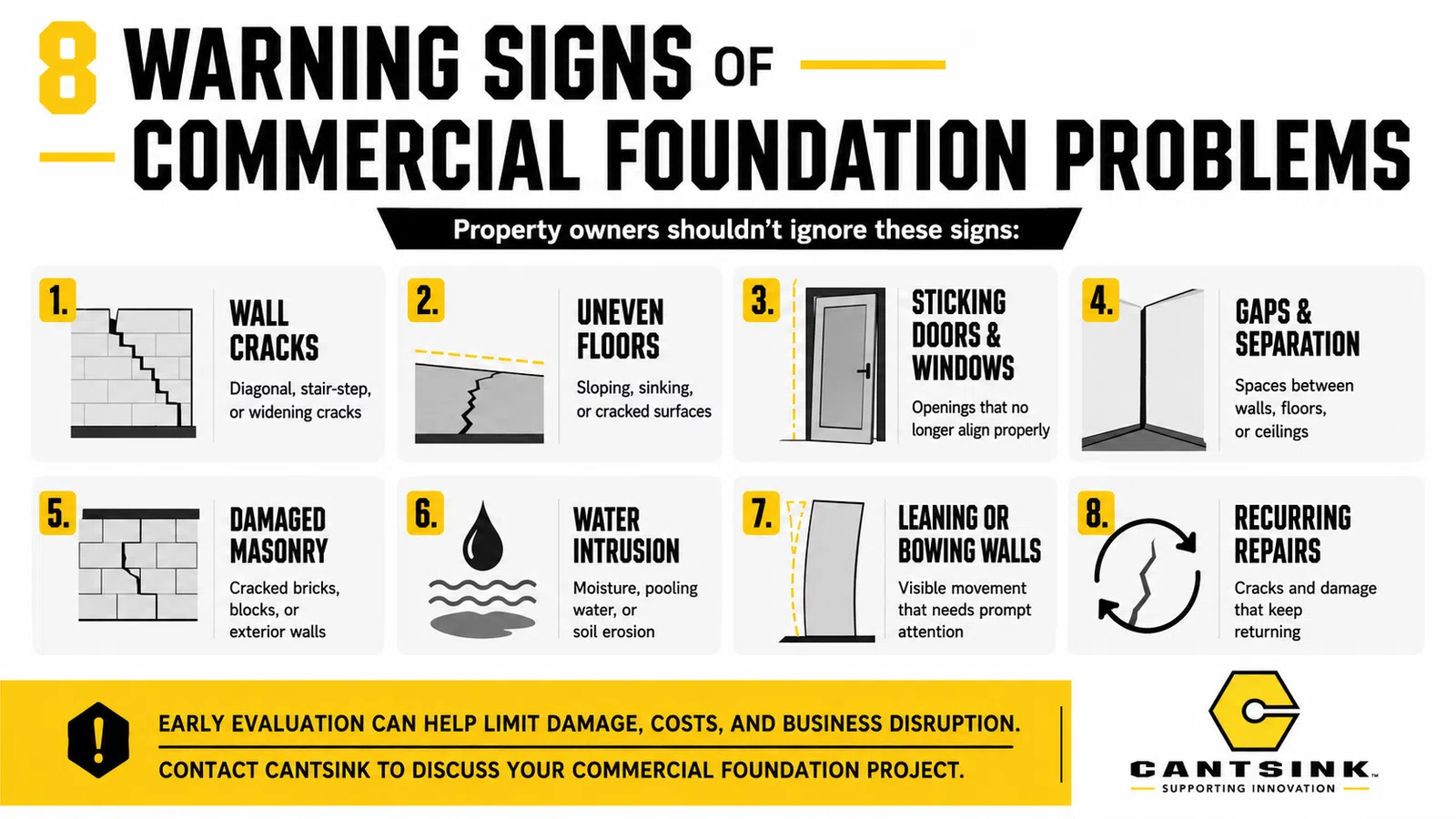
1. Cracks in Interior or Exterior Walls
Cracks are among the most recognizable signs of foundation movement, but not every crack has the same significance.
Small hairline cracks in finishes may result from normal material shrinkage. Cracks that widen, spread, reappear after being repaired, or follow a diagonal or stair-step pattern are more concerning.
Commercial property owners should pay particular attention to:
- Diagonal cracks extending from windows or doors
- Stair-step cracks in brick or concrete masonry
- Horizontal cracks in foundation or basement walls
- Cracks that are wider at one end
- Cracks that continue through multiple materials
- Separation between exterior walls and architectural elements
- Previously repaired cracks that have reopened
The location, direction, and width of a crack can provide valuable information about how the building is moving. Photographing and measuring cracks over time may help determine whether the damage is stable or progressing, but visible cracking should still be assessed by a qualified professional.
2. Uneven, Sloping, or Sinking Floors
A commercial floor should generally feel level and stable. Floors that slope, dip, bounce, or appear to be sinking may indicate that the supporting soil or foundation system has moved.
These changes may be especially noticeable in:
- Warehouses with long floor spans
- Retail spaces with tile flooring
- Office hallways
- Manufacturing facilities
- Parking structures
- Areas supporting heavy equipment
- Building additions or transition points
Floor problems may also interfere with business operations. Storage racks can become unstable, equipment may fall out of alignment, wheeled carts can roll unexpectedly, and flooring materials may crack or separate.
In some cases, the issue is limited to the concrete slab. In others, slab movement may be connected to a broader foundation problem. A professional evaluation can help distinguish between slab settlement, structural settlement, and damage caused by other building components.
3. Doors and Windows That Stick or No Longer Align
A door that suddenly becomes difficult to open may seem like a maintenance issue. However, when several doors or windows begin sticking at the same time, foundation movement may be affecting the building's frame.
Warning signs include:
- Doors that swing open or closed by themselves
- Gaps between doors and their frames
- Windows that are difficult to open
- Cracks radiating from door or window corners
- Doors that scrape the floor
- Misaligned locks or latches
- Window frames that appear twisted
Seasonal humidity can affect certain building materials, but persistent or worsening alignment problems should not be dismissed. Openings are often among the first places where structural movement becomes visible because they represent natural interruptions in a wall.
4. Gaps Between Walls, Floors, or Ceilings
Foundation movement can cause different parts of a building to pull away from one another. Property owners may notice gaps where walls meet floors, ceilings, columns, or exterior surfaces.
Common examples include:
- Interior walls separating from ceilings
- Baseboards pulling away from floors
- Exterior walls separating from window frames
- Gaps around columns or support posts
- Separation between an original building and an addition
- Expansion joints opening beyond their intended width
- Walls pulling away from cabinets or built-in fixtures
These gaps may indicate that one portion of the structure is moving independently from another. They can also allow air or water intrusion, creating additional maintenance problems.
5. Cracked or Separating Exterior Masonry
Brick, concrete block, stone, and other masonry materials are strong but relatively inflexible. When the foundation shifts, masonry may crack or separate because it cannot bend with the movement.
Stair-step cracking along mortar joints is a particularly common sign of settlement. Property owners may also observe:
- Bulging or bowing walls
- Cracked bricks or blocks
- Separation around exterior openings
- Gaps between masonry and adjoining materials
- Leaning parapet walls
- Displaced exterior panels
- Cracking near building corners
Exterior masonry damage can create safety concerns if loose materials are located above sidewalks, entrances, parking areas, or loading zones. It can also allow water to enter the building envelope, potentially causing corrosion, mold, or interior deterioration.
6. Water Intrusion and Persistent Moisture
Water and foundation problems often reinforce one another. Poor drainage can weaken or wash away supporting soil, while foundation cracks can create new paths for water to enter the building.
Signs of a potential water-related foundation issue include:
- Standing water near the building
- Water entering through foundation cracks
- Dampness in basements or lower levels
- Recurring mold or mildew
- Efflorescence on concrete or masonry
- Soil erosion around footings
- Downspouts discharging near the foundation
- Depressions forming along the building perimeter
Leaks from underground plumbing or utility systems can also erode soil without producing obvious surface evidence. An unexplained increase in water usage, recurring damp areas, or localized settlement may justify further investigation.
Correcting the drainage or leak is important, but it may not reverse settlement that has already occurred. The foundation and underlying soil should be evaluated separately to determine whether structural stabilization is needed.
7. Leaning, Bowing, or Rotating Walls
Walls that lean, bow, or rotate require prompt attention. These symptoms may be caused by soil pressure, inadequate reinforcement, foundation settlement, or deterioration of structural components.
Possible warning signs include:
- Basement walls bowing inward
- Exterior walls leaning away from the building
- Columns that no longer appear vertical
- Cracks that increase in width from bottom to top
- Rooflines that appear uneven
- Visible rotation near a building corner
Because wall movement may present an immediate safety risk, areas with significant displacement should be evaluated as soon as possible. A structural professional can determine whether temporary safety measures or access restrictions are necessary.
8. Problems With Loading Docks and Concrete Aprons
Loading areas experience heavy traffic and concentrated loads, making settlement especially disruptive. A sinking slab near a loading dock can create misaligned dock plates, drainage problems, and trip hazards.
Watch for:
- Gaps between the building and concrete apron
- Sunken pavement near dock doors
- Cracking around loading areas
- Water pooling against the structure
- Uneven transitions between slabs
- Dock equipment that no longer aligns properly
Ignoring these problems can affect employee safety, delivery schedules, vehicles, and material-handling equipment. Settlement near a loading dock may also indicate erosion or weak soil conditions that extend beneath nearby parts of the building.
9. Changes in Utility Lines or Building Systems
Foundation movement can place stress on plumbing, electrical conduits, fire-suppression systems, HVAC lines, and other utilities.
Property owners may notice:
- Repeated plumbing leaks
- Broken or separated drain lines
- Unexplained water loss
- Misaligned pipes
- Damaged utility connections
- HVAC equipment shifting out of position
- Sprinkler lines requiring repeated repair
Repairing the damaged utility without addressing the movement that caused it may lead to recurring failures. When multiple building systems experience alignment or connection problems, the foundation should be considered as a possible underlying cause.
10. Previous Repairs That Continue to Fail
Repeated cosmetic repairs are another warning sign. If cracks are patched but return, doors are adjusted but begin sticking again, or flooring is replaced only to crack in the same area, the building may still be moving.
Cosmetic repairs can improve appearance temporarily, but they do not stabilize the foundation or strengthen the supporting soil. Recurring damage often indicates that the underlying cause has not been resolved.
A documented history of repeated repairs can help engineers and foundation professionals identify patterns and determine how quickly the movement is progressing.
Why Delaying Commercial Foundation Repair Can Be Costly
Foundation problems rarely improve on their own. Continued movement can spread damage into walls, floors, roofing systems, utilities, and exterior finishes. A problem initially affecting one section of a building can eventually interfere with a much larger area.
Delays may lead to:
- Higher repair costs
- Increased safety risks
- Damage to inventory or equipment
- Business interruptions
- Tenant complaints
- Reduced property value
- Insurance complications
- Accessibility issues
- Code-compliance concerns
- More extensive restoration after stabilization
For commercial properties, the indirect cost of foundation damage can be as significant as the repair itself. Closing a retail space, relocating employees, or interrupting warehouse operations can quickly become expensive. Early evaluation allows owners to plan repairs more strategically and potentially limit disruption.
How Commercial Foundations Can Be Stabilized
The appropriate repair method depends on the building, foundation type, soil conditions, structural loads, and cause of movement. There is no universal repair that works for every property.
For structures experiencing settlement, helical piles may be used to transfer loads from unstable surface soils to stronger, more reliable soil layers. The piles are mechanically advanced into the ground and can be connected to the existing foundation with engineered brackets.
Potential advantages of helical foundation systems include:
- Installation in areas with limited access
- Minimal vibration compared with some traditional methods
- The ability to monitor installation torque
- Immediate load-transfer capability
- Limited excavation in many applications
- Use in both repair and new-construction projects
A commercial repair plan may also involve underpinning, slab support, drainage improvements, soil remediation, or other engineered measures. The solution should be based on a thorough site evaluation rather than visible symptoms alone.
What to Do If You Notice Warning Signs
If you suspect a foundation problem, document the affected areas and arrange for a professional assessment by a Cantsink engineer. Avoid relying exclusively on cosmetic repairs or assumptions about the cause.
Gathering the following information can be helpful:
- When the symptoms first appeared
- Whether the damage is progressing
- Records of previous repairs
- Construction drawings, if available
- Plumbing or drainage reports
- Recent renovation or equipment changes
- Photographs showing changes over time
- Information about nearby excavation or flooding
Depending on the severity and complexity of the issue, the evaluation may involve a structural engineer, geotechnical engineer, foundation contractor, or combination of professionals.
Protect Your Commercial Property With an Early Evaluation
Cracked walls, uneven floors, sticking doors, water intrusion, and recurring repairs should not be considered routine building maintenance until the underlying cause is understood. These symptoms may indicate foundation movement that could eventually affect safety, operations, and property value.
Cantsink provides helical pile and foundation support solutions for commercial, industrial, and institutional properties. Our team works with property owners, engineers, contractors, and facility managers to develop solutions based on the building's structural requirements and site conditions.
If you have noticed possible signs of settlement at your commercial property, contact Cantsink to discuss the project and determine the appropriate next steps. Addressing the issue early can help protect the structure, control repair costs, and reduce disruption to your business.

