

Every structure needs a dependable way to carry weight and transfer forces safely. Whether supporting a commercial building or anchoring a ground-mounted solar array, steel I-beams can play an important role in that process. Their recognizable shape provides an efficient combination of strength, stiffness, and material use, making them a familiar choice across the construction industry.
For developers, contractors, and property owners, understanding I-beams starts with understanding their purpose. A beam spanning an opening performs a different job from a steel section driven into the ground, even when their shapes look similar.
At Cantsink, I-beam services focus on ground-mount stability for solar equipment where soil conditions are suitable for driven piles. Here is how these versatile steel members work and what makes them valuable.
What Is an I-Beam?
An I-beam is a structural member with a cross-section resembling a capital letter I. It consists of two flanges connected by a central web. The flanges form the top and bottom of the shape when the member is positioned as a conventional horizontal beam.
This arrangement places much of the steel away from the section's center, helping the member resist bending efficiently about its strong axis. The web connects the flanges and carries much of the shear associated with typical beam loading.
People sometimes use I-beam, H-beam, wide-flange beam, and H-pile interchangeably. However, these terms can describe different section families with different proportions and properties. The specified section, steel grade, orientation, and connections determine how a member performs. Contractors and engineers can explore Cantsink's technical resources for information about its foundation support products.
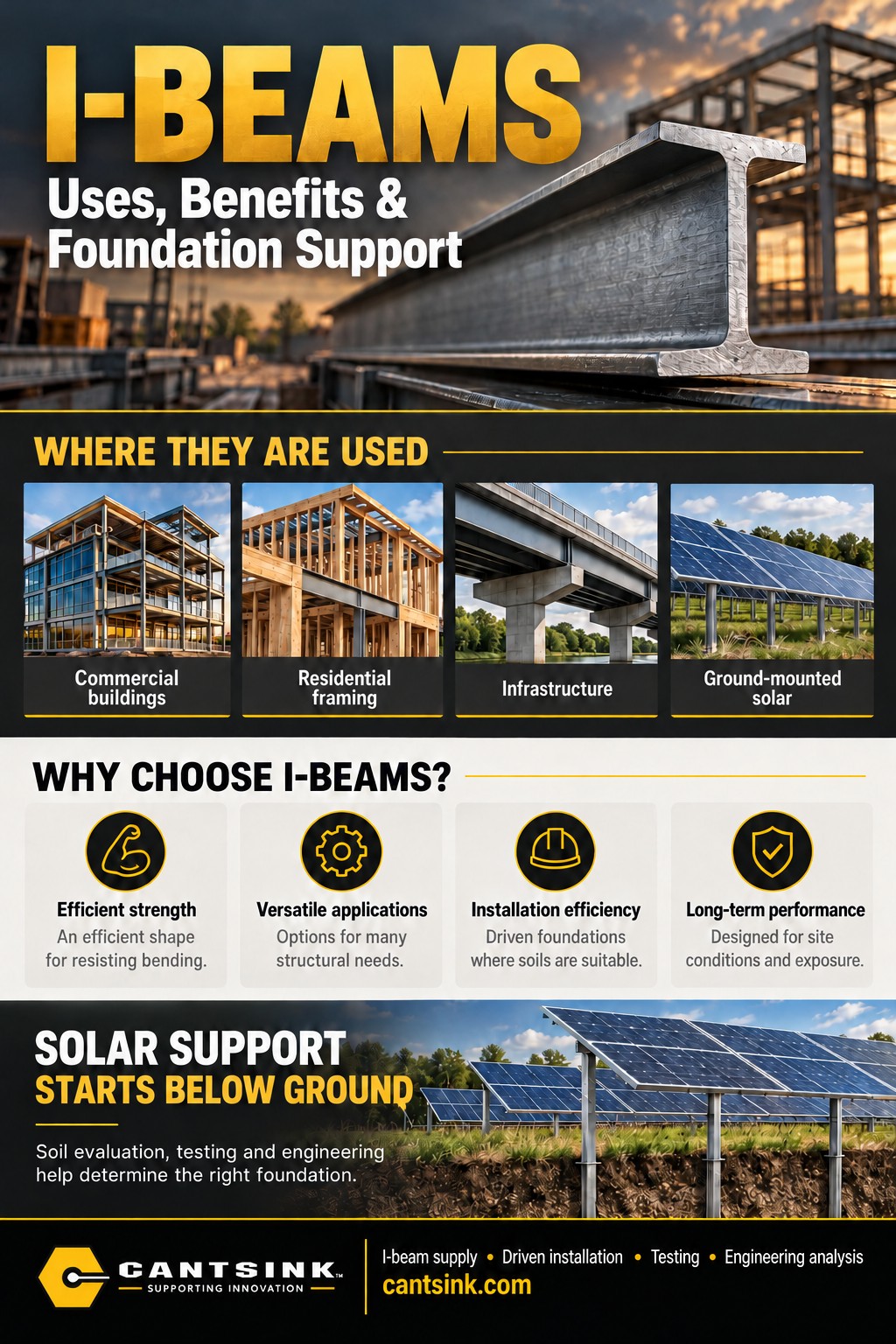
How Do I-Beams Work?
When a horizontal beam carries a downward load, it tends to bend. In a typical simply supported arrangement, the upper portion experiences compression while the lower portion experiences tension. The flanges help resist those bending stresses, and the web helps transfer forces between them.
A driven steel pile has a different role. Installed vertically into the ground, it transfers structural forces to the surrounding soil and, where applicable, to material beneath its tip. Its performance depends on both the steel section and the ground supporting it.
This distinction matters: a strong steel member does not automatically create a strong foundation. Soil resistance, embedment depth, installation quality, and the connection to the structure all influence the completed system.
Common Uses of I-Beams
Commercial and Industrial Buildings
Steel beams are widely used in building frames, roof systems, and floor assemblies. Their ability to carry substantial loads across engineered spans can help create open interior spaces for warehouses, manufacturing facilities, offices, and other commercial properties.
For projects requiring support below the building frame, Cantsink's commercial foundation solutions address new construction and remedial foundation needs.
The practical benefit is flexibility. Fewer interior supports may make it easier to arrange equipment, circulation routes, or work areas. Actual spacing depends on the complete framing design, including deflection limits, bracing, and connection requirements.
Residential Construction and Renovations
In residential projects, steel beams may support floor systems or replace portions of load-bearing walls when an open layout is desired. They can also be incorporated into engineered repairs where existing support members are inadequate or deteriorated.
When the problem involves the foundation beneath the framing, Cantsink's remedial support services offer a separate approach to foundation stabilization.
Adding a steel beam requires more than selecting a member that fits the opening. The supports at each end must carry the new reactions, and those forces must continue safely through the building to an adequate foundation.
Foundation and Infrastructure Applications
Selected steel sections can serve as driven piles beneath structures or as members within engineered support systems. Depending on the project, these systems may support transportation infrastructure, equipment platforms, or other structures requiring dependable load transfer.
The appropriate pile section and installation method depend on geotechnical conditions and structural demands. A section used successfully on one property may not be suitable for another site with different soil layers or obstructions.
Ground-Mounted Solar Installations
Solar installations are particularly relevant to Cantsink's I-beam services. Driven steel sections can provide foundation support for racking and tracker systems when site conditions allow.
These foundations must address more than equipment weight. Wind can push sideways against an array or create uplift, while the racking arrangement determines how those forces reach individual supports. Keeping foundation movement within the system's design limits helps protect alignment and structural performance.
Key Benefits of Steel I-Beams
1. Efficient Strength and Stiffness
The I-shaped profile uses steel efficiently for bending about its strong axis. Compared with a solid rectangular section of similar depth, it can provide useful structural performance with less material, depending on the dimensions and loading.
This efficiency gives designers options when balancing member weight, span, and structural depth. The section still needs checks for bending, shear, buckling, and serviceability; its familiar shape does not establish its allowable capacity.
2. Versatility Across Different Projects
Steel sections are available in a range of sizes and weights, allowing engineers to select members for different demands. Connections and fabrication details can adapt them to many structural arrangements.
That versatility is valuable for projects with varying elevations, support spacing, or equipment layouts. It also makes early coordination important, because the beam or pile must work with the surrounding structure rather than function as an isolated component.
3. Potential for Efficient Installation
Where the soil is suitable, driven I-beam foundations can offer an efficient installation approach. A pile-driving operation may eliminate the need for a cast-in-place concrete footing at each support location.
Avoiding concrete placement and curing at those locations can simplify scheduling. However, production rates depend on access, equipment, ground conditions, tolerances, and inspection requirements. Rock, buried debris, or driving refusal may require a revised installation approach.
4. Long-Term Performance with Appropriate Protection
Steel members can provide durable structural support when their design accounts for the exposure environment. Outdoor and buried applications require attention to corrosion, moisture, and soil chemistry.
Protective coatings, galvanizing, corrosion allowances, or other measures may be appropriate, depending on project requirements. The engineer must also consider connections and transitions near the ground surface. Long-term performance comes from matching the entire system to its intended service conditions.
5. Potential Project Cost Savings
An efficient steel section and a suitable installation method can help control project costs. On a favorable solar site, driven piles may reduce concrete work, excavation, and associated coordination.
The lowest purchase price does not necessarily produce the lowest installed cost. Beam length, driving difficulty, testing, corrosion protection, transportation, and remediation all affect the budget. Evaluating these factors early provides a more realistic comparison between foundation options.
Why Soil Conditions Matter
Soil conditions are central to deciding whether driven I-beams are appropriate. Loose layers, variable fill, dense material, groundwater, and buried obstructions can affect installation and foundation resistance in different ways.
A solar site may also contain meaningful variations across its footprint. Conditions near one row of panels may differ from those near another, making representative investigation and testing valuable.
Cantsink's pull testing services help inform solar pile foundation selection by evaluating conditions at locations across a project site. Testing provides information for the engineering process, helping teams assess proposed sections and embedment requirements before full production installation.
A testing program should reflect the loads and acceptance criteria established for the project. Installation depth alone does not confirm that a foundation meets every performance requirement.
I-Beams and Helical Piles: Choosing the Right Approach
Driven I-beams and helical piles can both support structures, but they are installed differently and interact with soil differently. Driven sections are advanced using pile-driving equipment. Helical piles are rotated into the ground, where their helix plates develop resistance in suitable soil.
The choice depends on loading, soil conditions, access, installation constraints, and the structure being supported. Neither approach is automatically the best option for every project. For building projects, learn more about Cantsink's new construction support using helical pile foundation systems.
Some developments may use different foundation solutions for different components. A solar project, for example, can have distinct support requirements for panel racking and electrical equipment platforms. Evaluating each application helps the project team select a practical foundation strategy.
Supporting Solar Projects with Cantsink
Cantsink supplies domestic I-beams for solar applications and offers beam driving, testing, and engineering analysis. Bringing these services into the planning process helps connect product selection with installation conditions and foundation requirements.
For EPC firms, developers, and contractors, early coordination can clarify responsibilities, identify testing needs, and reveal potential installation challenges. Reviewing foundation requirements alongside racking layouts and site information also helps reduce avoidable changes during construction.
Cantsink's broader commercial solar services address support needs across ground-mounted solar projects, allowing teams to discuss the requirements of different system components together.
Build on a Foundation Selected for Your Site
I-beams offer strength, versatility, and practical installation advantages across many construction applications. In ground-mounted solar projects, driven steel sections can provide effective foundation support when soil conditions, engineering, and installation methods align.
The best results begin with evaluating the site and designing a complete load path from the equipment into the ground. Contact Cantsink to discuss I-beam supply, driven installation, testing, and support options for your next solar project.

